
How to Automate Your Tour Inquiry-to-Itinerary-to-Invoice Process (Step-by-Step)
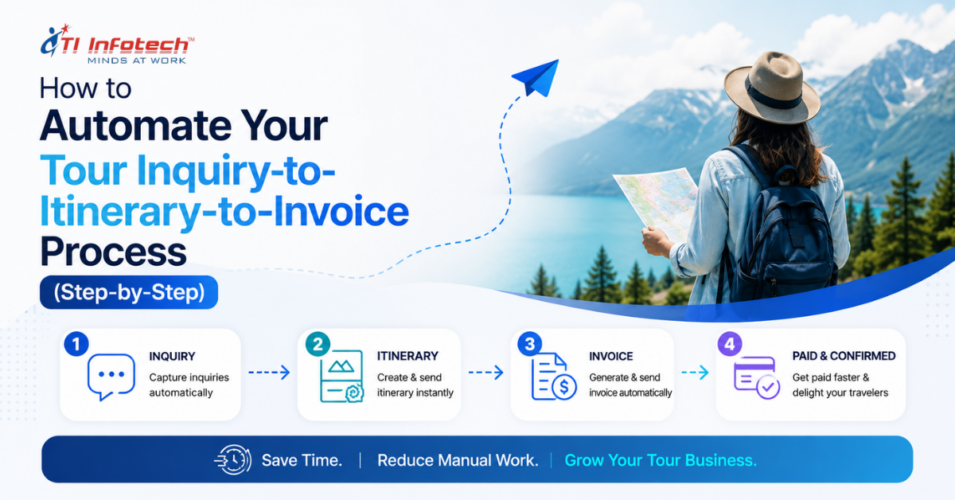
If you run a tour operation – whether you are a DMC, an inbound tour operator, or a travel agency – you already know what the daily grind looks like. A new inquiry lands in your inbox. You read it, note the destination and travel dates, pull up your supplier contacts, build a rough itinerary in Excel or Word, email it to the client, wait for approval, make a dozen revisions, and finally – sometimes days later – send out the invoice. Then you do it all over again. And again.
Sound familiar? You are not alone.
Most tour businesses still rely on a patchwork of spreadsheets, email threads, and manual data entry to manage this entire process. It works, until it doesn’t. One missed follow-up, one pricing error, one itinerary sent to the wrong client, and the fallout costs you time, money, and – worst of all – the client’s trust.
The good news is that every single step in this workflow can be automated. In this guide, we will walk you through the entire inquiry-to-itinerary-to-invoice process, show you exactly where automation fits in, and explain how tools like Tour Management Software can do heavy lifting for you.
Why Manual Tour Operations Are Costing You More Than You Think
Before diving into the “how,” let us take a moment to talk about the real cost of staying manual.
Time lost to repetitive tasks. Building a custom itinerary from scratch for every inquiry takes anywhere from 45 minutes to a few hours. Multiply that across 20–30 inquiries a month and you are losing several full working days just on document creation.
Human errors in pricing and invoicing. When you are manually pulling supplier rates, applying margins, and typing figures into an invoice template, mistakes happen. A wrong decimal or an outdated rate can eat directly into your margin – or worse, create disputes with the client after booking.
Slow response times. In today’s travel market, clients compare multiple operators at once. If your competitor sends a polished, personalized itinerary in two hours and you take two days, you have already lost the booking – regardless of how good your product is.
No visibility into the pipeline. Without a centralized system, it is almost impossible to answer basic questions like: How many open inquiries do you have right now? Which ones haven’t been followed up? What is your conversion rate this month?
Automation solves all of this – not by replacing your team, but by freeing them to do what humans do best: build relationships and close sales.
The 5 Stages of the Tour Inquiry-to-Invoice Workflow
To automate anything, you first need to understand it clearly. Here is a breakdown of the typical workflow:
Stage 1 – Inquiry Capture
A potential customer contacts you via your website enquiry form, email, WhatsApp, or phone. Their details, travel preferences, budget, and travel dates need to be captured and logged.
Stage 2 – Inquiry Management and Follow-Up
The inquiry is assigned to a sales agent. The agent reviews requirements, qualifies the lead, and sends an acknowledgement. Timely follow-up is scheduled.
Stage 3 – Itinerary Creation
Based on the client’s requirements, a tailored itinerary is built – selecting destinations, hotels, transfers, activities, and guides from your inventory.
Stage 4 – Quotation and Approval
A price quotation is sent to the client. Revisions happen (often multiple rounds). Once the client approves, the booking is confirmed.
Stage 5 – Invoice Generation and Payment
A proforma invoice (and later, a final invoice) is generated and sent. Payments are tracked, receipts issued, and vouchers sent to suppliers.
Now let us look at how each stage can be automated.
Step-by-Step: Automating Each Stage of the Process
Step 1 – Automate Inquiry Capture with an Integrated Web Form
Every inquiry your business receives should flow directly into a centralized CRM system – not into a shared email inbox where it can get missed or buried.
Set up an online inquiry form on your website that captures: the client’s name and contact details, travel destination and duration, number of travelers, budget range, preferred travel dates, and any special requests.
When a prospect fills out this form, a good travel agency software will automatically create a new lead record in your CRM. The inquiry gets timestamped, assigned to the right team member, and nothing falls through the cracks.
What to look for: A system that connects your website form directly to your sales pipeline – so every lead is logged, tracked, and visible in one place the moment it arrives.
Step 2 – Automate Inquiry Assignment and Follow-Up Reminders
Once an inquiry is in the system, the next risk point is delayed follow-up. Research consistently shows that responding to a travel inquiry within the first hour dramatically improves your chances of conversion.
With the right CRM for tour operators, you can automate:
- Auto-acknowledgement emails sent to the client the moment their inquiry is received, confirming that your team is on it.
- Follow-up reminders and task alerts – so if an inquiry hasn’t been responded to within, say, 2 hours, the system flags it and nudges the agent.
The goal here is zero dropped leads. Every inquiry that enters your pipeline should be nurtured automatically until it converts – or until you consciously decide to mark it as lost.
Step 3 – Automate Itinerary Creation from a Live Inventory
This is where tour operator automation has the biggest impact on speed and accuracy.
Instead of building itineraries from scratch in a Word document – hunting for hotel details, copying and pasting descriptions, manually calculating costs – you should be pulling everything from a live inventory system.
Here is how it works in practice:
- Your system holds a master inventory of all your products: hotels, transfers, sightseeing options, guides, activities, and packages – all with up-to-date rates, descriptions, images, and availability.
- When you build an itinerary, you simply select components from this inventory. Day 1: airport transfer + hotel. Day 2: city tour + lunch. Day 3: excursion. And so on.
- The system assembles the itinerary document automatically – professionally formatted, with images, day-wise breakdown, inclusions, exclusions, and terms.
- Costs are calculated based on the number of travelers, supplier rates, and your markup rules.
What used to take two hours now takes fifteen minutes.
Tour Management Software from TI Infotech does exactly this – it allows tour operators and DMCs to create custom, tailor-made itineraries from their live inventory, cutting itinerary creation time by a significant margin while ensuring pricing accuracy.
Pro tip: Set up package templates for your most popular destinations. For repeat routes – say, a 7-night Kerala package or a 5-day Rajasthan tour – a template gives you a 90% complete itinerary in seconds, which you then personalize for the client.
Step 4 – Automate Quotation Delivery and Revision Tracking
Once the itinerary is built, it needs to go to the client as a polished quotation – and you need to track what happens next.
With a connected destination management system, you can:
- Send branded quotation documents directly from the system via email – no downloading, reformatting, and reattaching.
- Manage revision rounds cleanly. When a client asks to swap a hotel or add an extra excursion, you update the itinerary in the system and resend. The version history is maintained, and there is no risk of sending an outdated version.
The result is faster, more professional client experience that builds confidence and shortens your sales cycle.
Step 5 – Automate Invoice Generation, Payments, and Vouchers
Once a client confirms, the paperwork begins – and this is another area where manual processes create unnecessary risk.
A fully automated tour booking workflow should handle:
Proforma Invoice (PI) generation: The moment a booking is confirmed, the system generates a proforma invoice, pulling all the details – client name, tour details, payment schedule, total cost – from the confirmed itinerary. No retyping, no formatting.
Final Invoice: Once payment is received, the final tax invoice is generated automatically. Travel Assist, for example, includes auto-generated invoicing that saves time and ensures clients always have an accurate record of their booking.
Payment tracking: The system tracks which payments have been received, which are due, and which are overdue – and capable of sending automated payment reminders to clients so your team doesn’t have to chase manually.
Supplier vouchers: Once a booking is confirmed and paid, the system can generate and send vouchers to your hotels, transport suppliers, and guides automatically – removing another manual step entirely.
Receipts: Receipts are generated and sent to clients instantly on payment confirmation.
All of this connects back to your accounting module, giving you a real-time view of your revenue, outstanding balances, and financial position – without anyone having to reconcile a spreadsheet at the end of the month.
What Does a Fully Automated Tour Operation Look Like?
Let us put this all together with a real-world example.
Before automation: A new inquiry for a 10-night Sri Lanka tour arrives by email on Monday morning. Your sales agent reads it, sends a manual acknowledgement, spends the afternoon building an itinerary in Word, checks hotel rates with three different suppliers, creates a quotation in Excel, emails it across – and it reaches the client on Tuesday evening. The client comes back with two hotel change requests on Thursday. The agent rebuilds the document. By the time the booking is confirmed the following week, the agent has spent roughly 6 hours on this single inquiry.
After automation: The same inquiry comes in via your website form. An auto-acknowledgement hits the client’s inbox in seconds. The assigned agent gets a task notification. They open the system, select destinations and components from the live inventory, build the itinerary in 20 minutes, and send a branded quotation directly from the platform. The client opens it (the agent is notified). They request two hotel changes – the agent updates the itinerary in the system in five minutes and resends. The client confirms. A proforma invoice is auto-generated and sent. Supplier vouchers go out automatically. Total time spent by the agent: under 45 minutes.
That is not just efficiency. That is a competitive advantage.
Key Features to Look for in Tour Automation Software
Not all software is created equal. When evaluating a tour management or automation platform, here are the capabilities that matter most:
- Centralized CRM with lead tracking, follow-up automation, and pipeline visibility
- Contract management for hotels, transport, guides, and activities with contracted pricing
- Itinerary builder branded document output available in different language – English, French, German and so on.
- Integrated quotation module with version control and delivery tracking
- Auto-invoice generation for proforma invoices, final invoices, and receipts
- Supplier voucher automation linked to booking confirmations
- Accounting and MIS reporting for financial visibility without manual reconciliation
TI Infotech’s tour and travel software suite covers all of these functions in a single platform, specifically built for tour operators, DMCs, and travel agencies managing complex, customized itineraries, MICE Operations.
Final Thoughts
Automating your tour inquiry-to-itinerary-to-invoice process is not a future investment – it is a present-day necessity. The operators who are winning in today’s market are not necessarily the ones with the best products; they are the ones who respond fastest, pitch most professionally, and close most efficiently.
Every day you spend managing this workflow manually is a day your competition is using to respond to more inquiries, build more itineraries, and send more invoices – all in the time it takes you to format a single document.
The technology to automate this entire process exists, it is affordable, and it is built specifically for the travel industry. The question is not whether to make the switch – it is how soon you can get started.
Ready to see what a fully automated tour workflow looks like for your business? Explore TI Infotech’s Tour Management Software and take the first step toward running a leaner, faster, and more profitable operation.
To know more please contact us