
Why Every Business Needs a Strong Disaster Recovery Strategy
Introduction
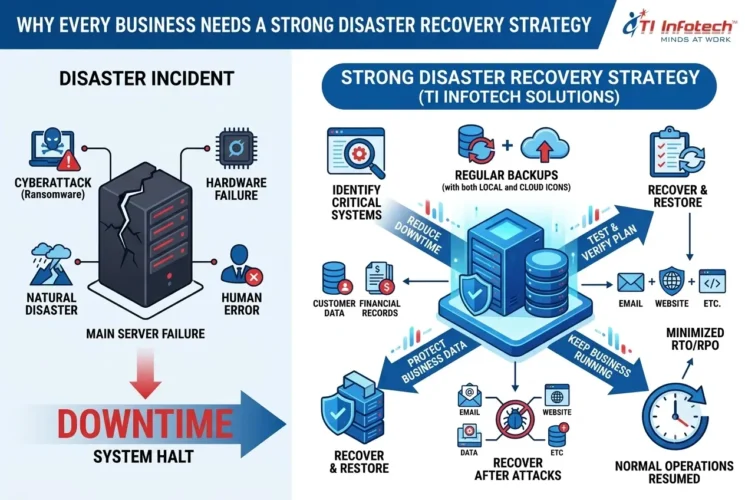
Imagine your company’s main server suddenly stops working. Your team cannot access important files, customers cannot use your services, and work comes to a halt.
This can happen because of a cyberattack, hardware failure, power outage, human error, or even a natural disaster. Without a plan, getting everything back to normal can take a lot of time and money.
That is why every business needs a strong disaster recovery strategy. With the right IT infrastructure management services, businesses can protect their data, reduce downtime, and get their systems back up and run faster.
What Is a Disaster Recovery Strategy?
A disaster recovery strategy is simply a plan for what a business will do if its IT systems stop working.
It helps a company protect and restore important things such as:
- Business data
- Servers
- Applications
- Networks
- Cloud systems
- Important files
It is important to understand that backup and disaster recovery are not the same thing.
A backup is a copy of your data. Disaster recovery is the plan and process used to bring your systems and data back after something goes wrong.
Why Is Disaster Recovery Important for Businesses?
-
It Helps Reduce Downtime
When IT systems stop working, employees may not be able to do their jobs. Customers may also face problems.
A good disaster recovery plan helps businesses restore important systems faster. This means less downtime and less disruption to daily work.
-
It Protects Important Business Data
Every business has important data. This could include customer information, financial records, employee files, business documents, and application data.
Losing this information can create serious problems.
Regular backups can help protect data from accidental deletion, hardware failure, cyberattacks, and other unexpected events.
Businesses can use data backup and restore services to create a more reliable backup process.
-
It Helps During Cyberattacks
Cyberattacks can stop businesses from accessing their systems and data. Ransomware is one example where attackers can lock important files and demand money.
A disaster recovery plan can help a business recover after such an incident.
It should also work with network security solutions to help protect business systems from security threats.
-
It Helps Keep the Business Running
Some systems are more important than others. For example, a company may need email, website, database, or payment system to work every day.
A disaster recovery plan helps businesses decide which systems should be restored first. This makes it easier to get important operations running again.
Key Parts of a Strong Disaster Recovery Strategy
A good disaster recovery plan usually includes the following:
- Regular backups: Make copies of important business data.
- Offsite or cloud backups: Keep another copy away from the main system.
- Recovery Time Objective (RTO): Decide how quickly a system needs to be restored.
- Recovery Point Objective (RPO): Decide how much recent data the business can afford to lose.
- Infrastructure recovery: Plan how servers, networks, and applications will be restored.
- Security: Protect backup systems from unauthorized access.
- Regular testing: Test the recovery plan to make sure it actually works.
For companies with complex IT systems, server management and disaster recovery services can help with server monitoring, maintenance, backup, security, and recovery.
How to Create a Disaster Recovery Plan
Creating a disaster recovery plan does not have to be complicated.
First, identify your most important systems and data. Then, think about what could go wrong and how it could affect your business.
Next, decide:
- What data needs to be backed up?
- Where will the backups be stored?
- How quickly should important systems be restored?
- Who will handle recovery during an emergency?
- How often will the plan be tested?
It is also important to update the plan regularly. Businesses add new software, cloud services, servers, and employees over time. Your recovery plan should change as your business changes.
A professional IT Facility Management solution can help businesses manage areas such as IT infrastructure, data backup, disaster recovery, networking, security, cloud computing, and remote infrastructure.
Frequently Asked Questions
What is disaster recovery in IT?
IT disaster recovery is the process of restoring important IT systems, applications, infrastructure, and data after something goes wrong.
Is data backup the same as disaster recovery?
No. A backup is a copy of your data. Disaster recovery is the larger plan for restoring your systems and data after an incident.
How often should a disaster recovery plan be tested?
Businesses should test their recovery plans regularly. They should also test them after major changes to their IT systems or applications.
Do small businesses need disaster recovery?
Yes. Small businesses also depend on data, computers, applications, and online services. A disaster recovery plan can help them deal with data loss, system failures, and cyberattacks.
Conclusion
No business can know when an IT problem will happen. But every business can be prepared for one.
A strong disaster recovery strategy can help protect important data, reduce downtime, and help employees get back to work faster. Regular backups, secure systems, clear recovery steps, and regular testing all play an important role.
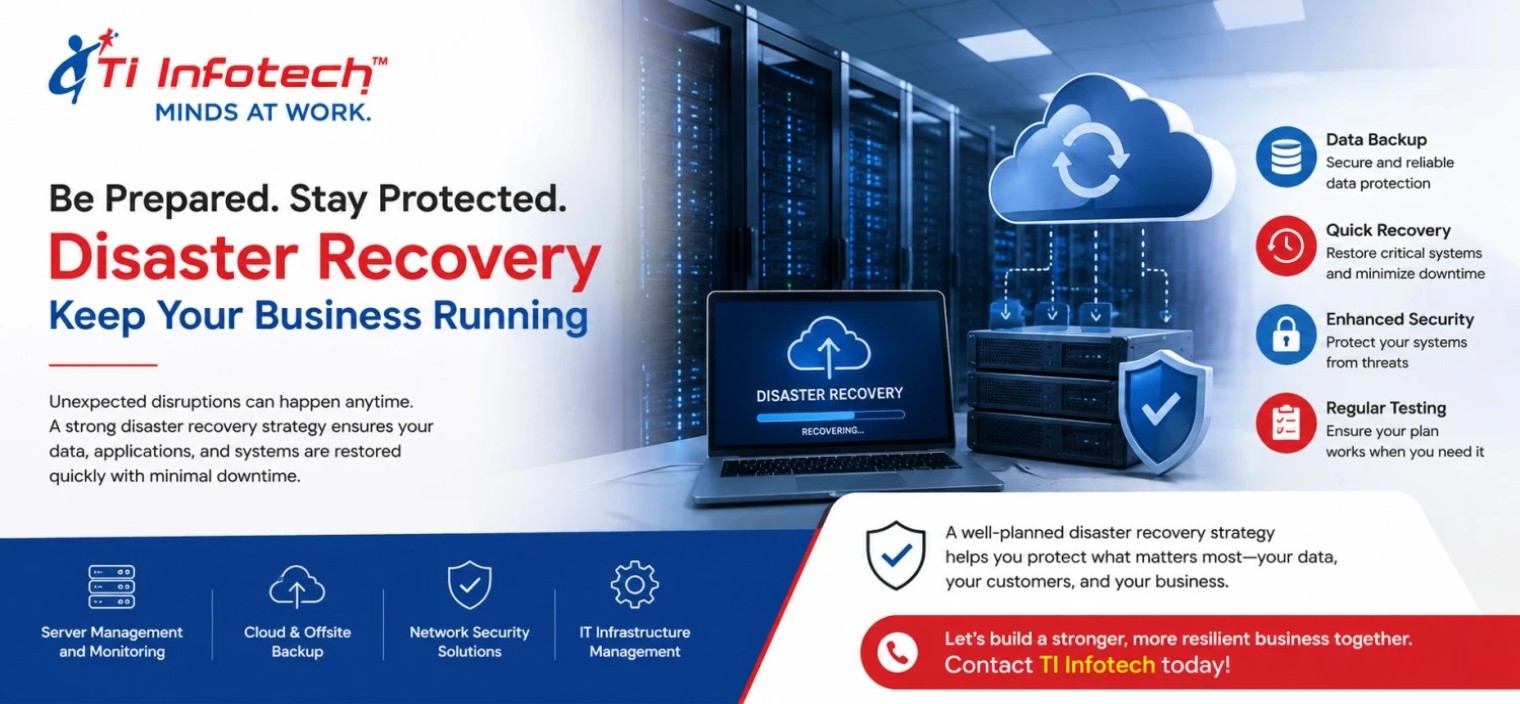
If you want to improve your company’s IT infrastructure and disaster recovery setup, explore TI Infotech’s IT infrastructure and disaster recovery solutions. You can also Contact Us to discuss your business requirements with the TI Infotech team.